Vortex wandering is a pervasive and important unsteady phenomenon in rotating fluid systems, characterized by random periodic deviations of the vortex core around its geometric center. Although the overall vortex structure remains stable, this deviation induces local velocity and pressure perturbations, affecting the global stability of the swirling flow field. Vortex wandering is not only significant in fundamental fluid dynamics research but also closely related to natural and engineering systems. In nature, it influences the internal structure and evolution of intense vortices like tornadoes; in engineering applications, it significantly impacts the separation efficiency and operational performance of rotating equipment such as cyclone separators and swirlers. However, due to its low-frequency, weak-signal characteristics, the dominant dynamic structure and topological features of vortex wandering have not been fully revealed.
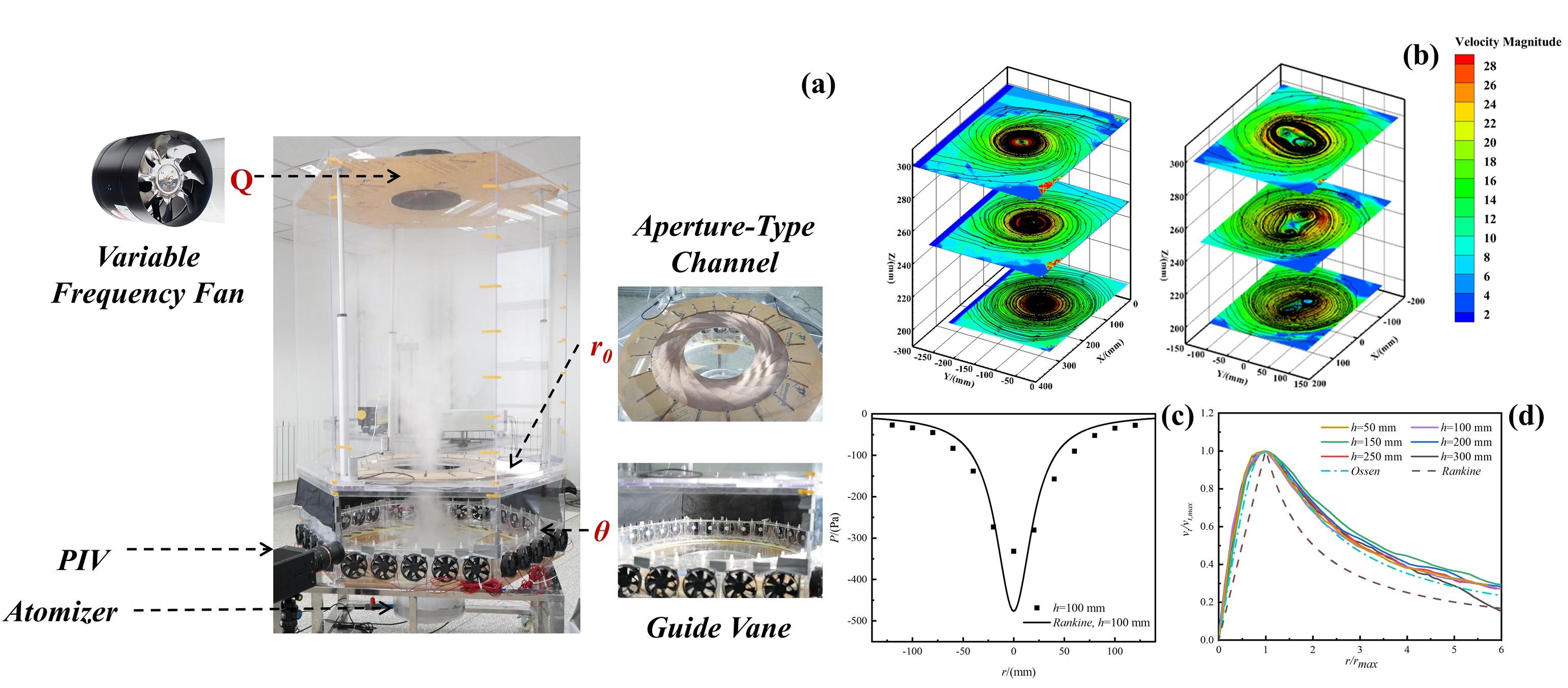
Figure 1. The experimental platform built by the team.
Addressing this issue, the GEE team constructed a highly controlled swirling flow experimental system. They acquired instantaneous velocity field data using high-temporal-resolution Particle Image Velocimetry (PIV) technology and applied the Sparsity-Promoting Dynamic Mode Decomposition (SP-DMD) method to extract low-frequency structures in the swirling system. The team experimentally identified the dominant dynamic mode of vortex wandering, revealing the spatial structure, spectral characteristics, and systematic evolution of this low-frequency behavior with variations in the swirl ratio.
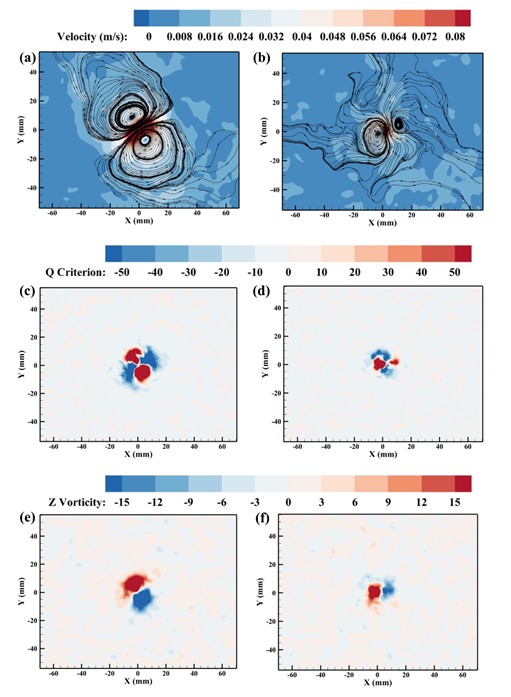
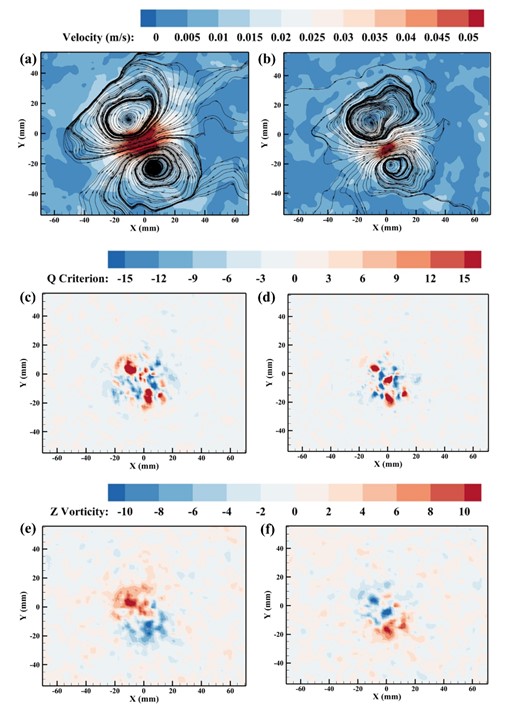
Figure 2. Flow structures of the second-order vortex-wandering-dominated mode under different swirl ratios.
The study found that the vortex wandering mode exhibits a typical antisymmetric dual-vortex structure, whose rotation direction is consistent with the primary vortex, effectively driving the deviation of the vortex core. As the swirl ratio increases, the energy proportion of the wandering mode gradually weakens, and its spatial topological structure transitions from clear and stable to a fragmented state, reflecting the evolution trend of the swirling system from a highly ordered state to a highly turbulent state. This research further established the link between the dominant mode of vortex wandering and the orderliness of the swirling flow, providing new experimental evidence for a deeper understanding of the stability of swirling systems and the dynamic mechanisms of low-frequency unsteady behaviors in natural and engineering vortices.
This research, entitled "Experimental Investigation of Vortex Wandering Dynamics in Single-Cell Tornado-Like Vortices", has been published in the Journal of Fluid Mechanics, a leading authority in fluid mechanics published by Cambridge University Press. The first author of the paper is Young Researcher ZHANG Yumeng of Lanzhou University, and the corresponding author is Professor WANG Bo. This work was supported by the National Natural Science Foundation of China (Grant No. 52400130).
Paper Link: https://doi.org/10.1017/jfm.2025.10862


