On the afternoon of December 2, 2025, the 22nd lecture of the "Yuxiu Resource and Environment·Celebrity Forum", hosted by the College of Earth and Environmental Sciences of Lanzhou University, was successfully held in Meeting Room 502 of Qilian Hall at the Chengguan Campus. The lecture featured Researcher Ran Youhua from the Northwest Institute of Eco-Environment and Resources, Chinese Academy of Sciences, who delivered a thematic presentation entitled Reinterpreting the Distribution, Evolution, and Impacts of Permafrost. The lecture was chaired by Professor Nian Yanyun from the Department of Information Geography and attracted a large audience of faculty members and students.
Researcher Ran Youhua, a researcher and doctoral supervisor at the Northwest Institute of Eco-Environment and Resources, Chinese Academy of Sciences, has long been engaged in permafrost geography research and has led several significant projects, including the Young Scientists Fund Program (Category A) of the National Natural Science Foundation of China (NSFC). He has achieved notable results in permafrost data integration, distribution mapping, and remote sensing of eco-hydrological processes in cold regions.
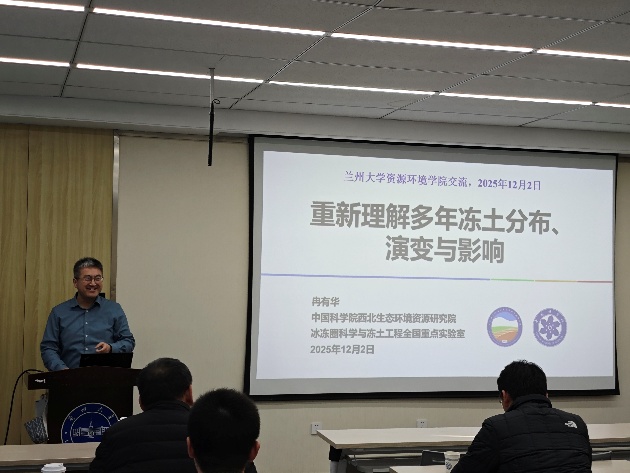
The report began with an overview of the fundamental characteristics of global permafrost and systematically elaborated on its distribution patterns and change trends in the Northern Hemisphere. Researcher Ran Youhua highlighted that permafrost, as a key component of the cryosphere, has a direct impact on the process of global climate changedue to its changes. Using extensive observational data and model simulations, he analyzed the spatiotemporal characteristics of permafrost degradation across different regions, emphasizing the profound impact of permafrost changes on the Tibetan Plateau—often referred to as the "Water Tower of Asia"—on regional water cycles. Regarding the mechanisms of permafrost evolution, the report provided a detailed explanation of the variations in key parameters, such as permafrost temperature and active layer thickness, driven by climate change. Researcher Ran also presented his team's findings based on multi-source remote sensing data and ground observation networks, systematically revealing the trends and spatial differences in ground temperature across China's major permafrost regions over the past 30 years. These studies provide critical scientific evidence for understanding the response mechanisms of permafrost to climate change.
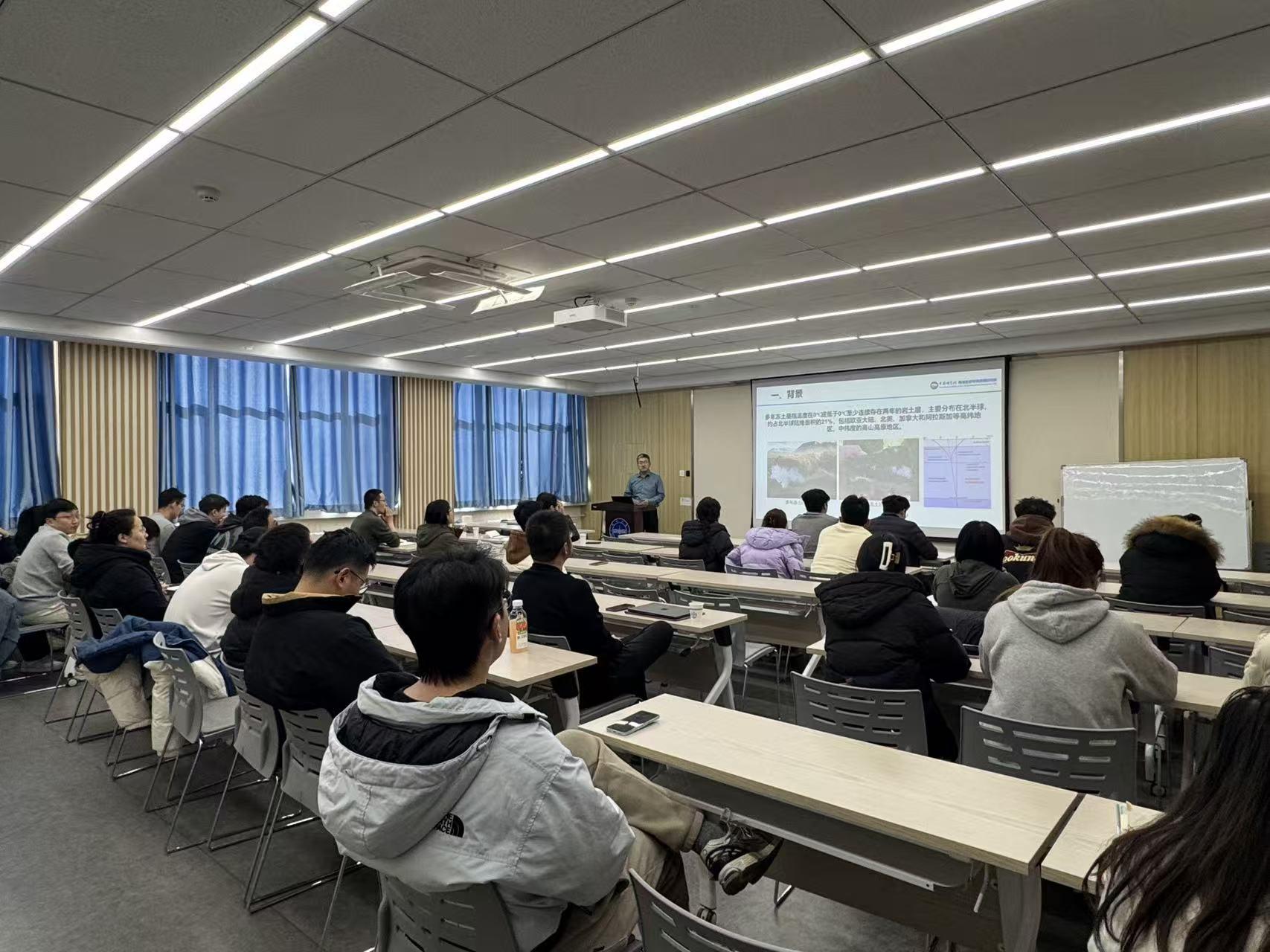
The lecture was held in a highly academic atmosphere, with lively interaction between the audience and the speaker. During the Q&A session, faculty and students actively raised questions and engaged in in-depth discussions with Researcher Ran Youhua on topics such as regional differences in permafrost changes, advances in remote sensing monitoring techniques, and the frontier of permafrost carbon cycle research. This academic lecture deepened participants' understanding of cutting-edge permafrost science and provided valuable methodological insights for research in related fields.


