Recently, the Ministry of Education awarded certificates for the 2025 Higher Education Institutions Outstanding Research Achievement Awards (Natural Sciences and Engineering Technologies). Led by Academician Chen Fahu, the environmental archaeology team's project, titled "The History of Xiahe Denisovans and Prehistoric Hunter-Gatherer Activities on the Tibetan Plateau", has been honored with the First Prize of the Natural Science Award for Outstanding Research Achievements in Higher Education Institutions for 2025. Lanzhou University and the Institute of Tibetan Plateau Research, Chinese Academy of Sciences, are respectively the first and second completing institutions. The main contributors include Professor Zhang Dongju, Academician Chen Fahu, Professor Xia Huan, Dr. Cheng Ting, and Dr. Wang Jian (listed in order of contribution).
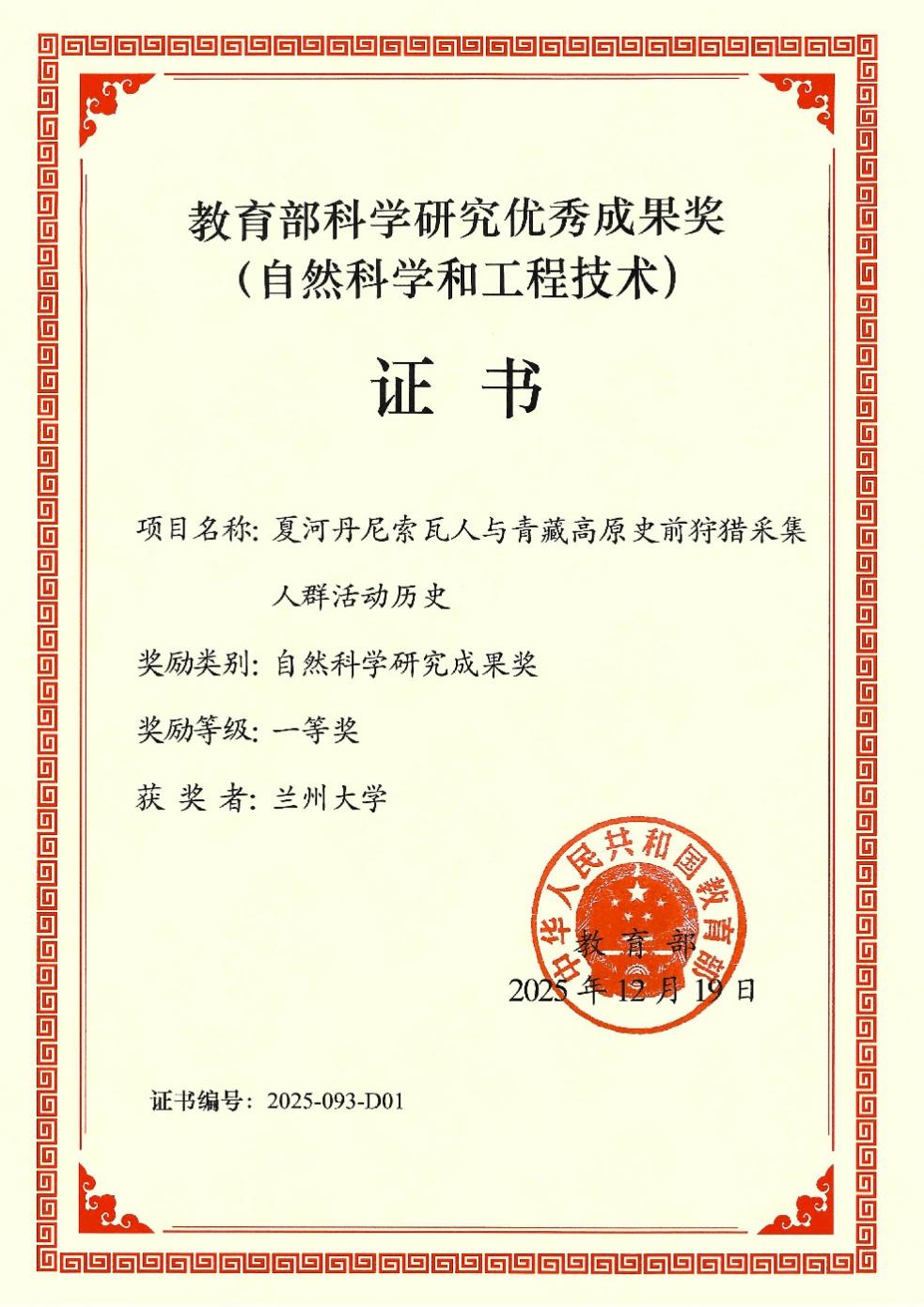
Figure 1. Award Certificate.
The unique high-altitude environment of the Tibetan Plateau has played a significant role in human evolution, dispersal, and environmental adaptation. It is an ideal region for gaining deeper insights into the evolutionary patterns of prehistoric human-environment interactions and has attracted extensive multidisciplinary attention. The core objective of this award-winning project is to reconstruct the activity history of prehistoric hunter-gatherers on the Tibetan Plateau and to understand the processes of human adaptation to extreme environments over long timescales. Over the past decade, the project team has systematically conducted extensive fieldwork, archaeological surveys, site excavations, and multidisciplinary research on the Tibetan Plateau and its surrounding regions. The main scientific findings are summarized as follows: 1. Discovery of continuous hunter-gatherer habitation on the Tibetan Plateau from the Middle-Late Pleistocene to the Mid-Holocene, pushing back the earliest evidence of human activity on the plateau to approximately 190,000 years ago. 2. First discovery of fossils and molecular biological evidence of an extinct hominin species—Denisovans—on the Tibetan Plateau, demonstrating their long-term presence before the arrival of modern humans. 3. Identification of at least two distinct prehistoric hunter-gatherer cultures (early and late periods) on the Tibetan Plateau, revealing different high-altitude environmental adaptation strategies employed by Denisovans and microblade-using populations.
The representative achievements of this project have been published in top-tier domestic and international academic journals such as Nature, Science, Quaternary Science Reviews, and Science China Earth Sciences (Chinese and English editions). They have been widely cited in papers published in prestigious journals including Nature, Science, Cell, and PNAS. The project has also garnered significant attention and coverage from authoritative domestic and international media outlets such as Xinhua News Agency, CCTV, BBC, New York Times, Times, and National Geographic. Experts interviewed have unanimously affirmed the reliability and importance of the project's findings. Furthermore, the achievements have been recognized with honors such as inclusion in Science's 2019 "Top 10 Scientific Breakthroughs of the Year", the Smithsonian Institution's 2020 "Top 10 New Insights in Human Origins Research", Archaeology's 2019 "Top 10 Archaeological Discoveries of the Year", the Chinese Ministry of Science and Technology's 2019 "Top 10 Scientific Advances in China", and the 2019 "Top 10 Science and Technology Advances in China" selected by academicians of the Chinese Academy of Sciences and the Chinese Academy of Engineering. These accomplishments have generated broad impact in both academic and public spheres.
The establishment of the Science Research Outstanding Achievements Award in Higher Education (Natural Sciences and Engineering Technologies) aims to thoroughly implement Xi Jinping's Thought on Socialism with Chinese Characteristics for a New Era and the spirit of the 20th National Congress of the Communist Party of China. It also seeks to implement the plans from the National Education Conference and the National Science Conference, vigorously promote the strategy of revitalizing the country through science and education, the strategy of strengthening the country with talent, and the strategy of innovation-driven development. The award further guides universities to adhere to the "Four Orientations", accelerates the integrated deployment of education, science, and talent, continuously enhances innovation capabilities, accelerates the output of major scientific achievements, and supports the cultivation of high-quality talent.
Related Papers:
1. Chen, F., Welker, F., Shen, C.C., Bailey, S.E., Bergmann, I., Davis, S., Xia, H., Wang, H., Fischer, R., Freidline, S.E., Yu, T.L., Skinner, M.M., Stelzer, S., Dong, G., Fu, Q., Dong, G., Wang, J., Zhang, D., Hublin, J.J., 2019. A late Middle Pleistocene Denisovan mandible from the Tibetan Plateau. Nature 569, 409-412.
2. Zhang, D., Xia, H., Chen, F., Li, B., Slon, V., Cheng, T., Yang, R., Jacobs, Z., Dai, Q., Massilani, D., Shen, X., Wang, J., Feng, X., Cao, P., Yang, M.A., Yao, J., Yang, J., Madsen, D.B., Han, Y., Ping, W., Liu, F., Perreault, C., Chen, X., Meyer, M., Kelso, J., Pääbo, S., Fu, Q., 2020. Denisovan DNA in Late Pleistocene sediments from Baishiya Karst Cave on the Tibetan Plateau. Science 370, 584-587.
3. Cheng, T., Zhang, D., Smith, G.M., Jöris, O., Wang, J., Yang, S., Xia, H., Shen, X., Li, Q., Chen, X., Lin, D., Han, Y., Liu, Y., Qiang, M., Li, B., Chen, F., 2021. Hominin occupation of the Tibetan Plateau during the Last Interglacial Complex. Quaternary Science Reviews 265, 107047.
4. Wang, J., Xia, H., Yao, J., Shen, X., Cheng, T., Wang, Q., Zhang, D., 2019. Subsistence strategies of prehistoric hunter-gatherers on the Tibetan Plateau during the Last Deglaciation. Science China Earth Sciences 63, 395-404.
5. Zhang, D., Dong, G., Wang, H., Ren, X., Ha, P.u., Qiang, M., Chen, F., 2016. History and possible mechanisms of prehistoric human migration to the Tibetan Plateau. Science China Earth Sciences 59, 1765-1778.


