Recently, Professor MU Cuicui's team has made significant progress in the research on soil carbon components in the frozen ground regions of the Qinghai-Tibet Plateau. The results were published online on November 3, 2025, in Global and Planetary Change under the title "Aridity controls on the dominance of soil mineral-associated and particulate organic carbon in the Qinghai-Tibet Plateau".
Professor MU Cuicui is the corresponding author, and PhD student Liu Hebin is the first author of the paper. This research was supported by the National Key Research and Development Program of China (2024YFF0810900).
Soil organic carbon turnover depends heavily on the composition of particulate organic carbon (POC) and mineral-associated organic carbon (MAOC). However, the dominance of MAOC and POC is controversial, especially in the high-altitude cold regions, limiting our ability to predict changes in soil carbon pool. Notably, in recent decades,cold regions have been substantially affected by widespread drought events, which is expected to be more severe in the permafrost-affected areas. However, the impact of aridity on the contents and distributions of POC and MAOC is poorly understood in cold regions, especially in the QTP frozen ground regions. This will result in considerable uncertainty in the prediction of future soil carbon pool.
The research team conducted field transect surveys in the frozen ground regions (seasonal and permafrost) of the Qinghai-Tibet Plateau and combined this with data collection from literatures. Focusing on soil organic carbon fraction data, they utilized methods such as one-way analysis of variance (ANOVA), threshold models, and structural equation models (SEM) to reveal the distribution patterns of POC and MAOC and their drivers under different aridity indices. Results show that MAOC contents account for 66.5% and 58.4% of total SOC in arid and semi-arid areas; whereas POC dominates in humid and dry sub-humid soils with the proportions of 62.9% and 52.5%. Further analysis found that both MAOC and POC exhibit a nonlinear decline with aridity, with a threshold of 0.59. At low aridity levels, the direct effect of TN on MAOC and POC is highest, with a standardization effect of 0.97 and 0.80, respectively. Aridity has a direct positive effect on MAOC while directly inhibiting the POC accumulation. Meanwhile, aridity indirectly modulates both fractions primarily by influencing TN and soil moisture. Similarly, at high aridity levels, TN exerts a more pronounced direct positive influence on MAOC, with a standardization effect of 0.99. Furthermore, aridity further intensifies its impact on soil moisture, thereby strengthening the inhibitory effect on the formation of MAOC and POC.
This study highlights the discrepancy in the dominance of POC and MAOC with different aridity levels, which provide essential mechanism for superiorly predicting alpine soil carbon-climate feedback.
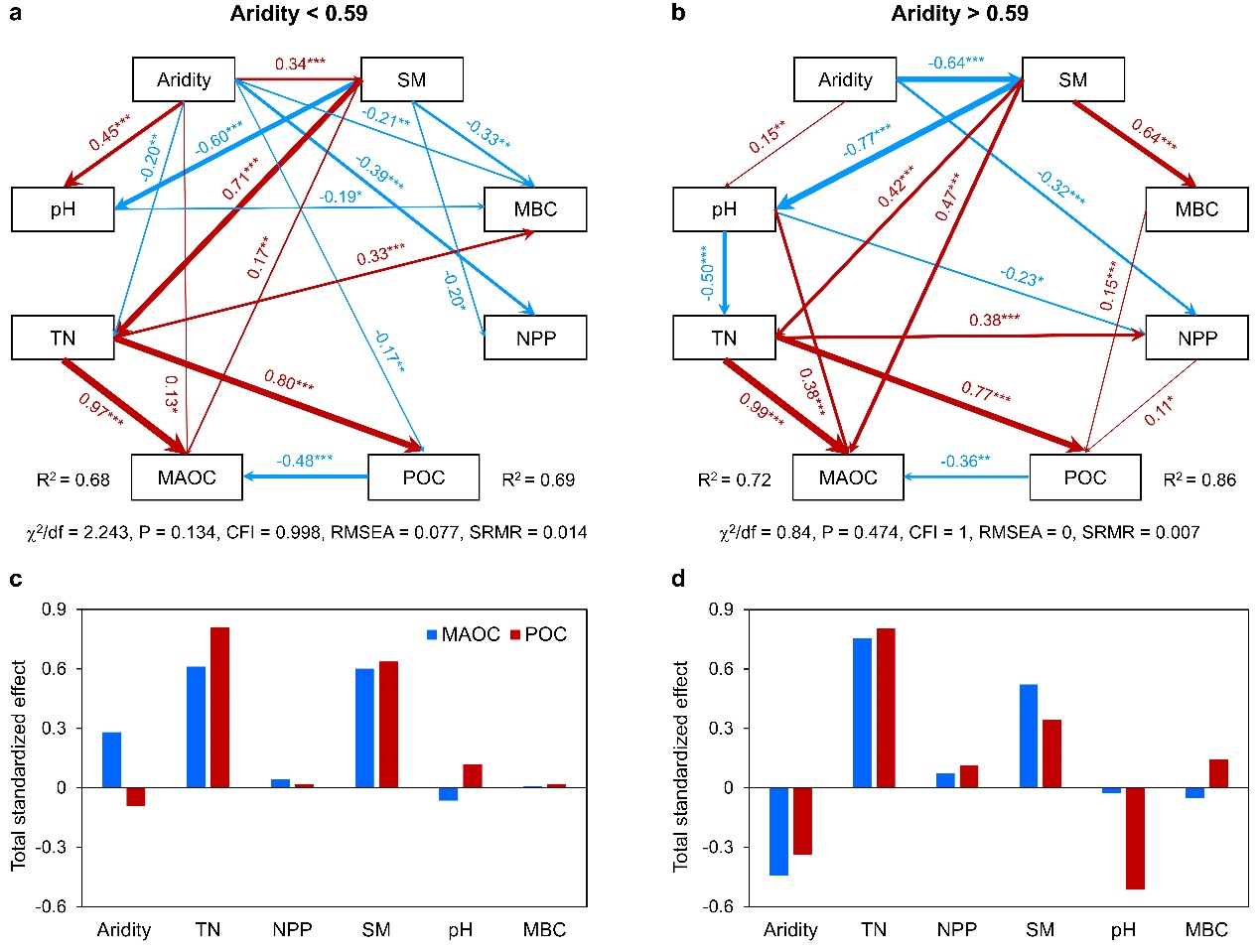
Figure 1. The direct and indirect effects on MAOC and POC contents at different aridity levels. (a-b) Path diagrams show direct and indirect effects of environmental variables on MAOC and POC at low (<0.59) and high aridity (> 0.59) levels. (c-d) The total standardized effects of environmental variables on MAOC and POC at low and high aridity levels.


