Equatorial glaciers are like icy "crowns" perched atop tropical alpine summits and serve as highly sensitive indicators of global climate change. Under ongoing global warming, however, tropical snow-and-ice landscapes—exemplified by Kilimanjaro—are receding at an accelerating pace. Because tropical alpine regions are frequently obscured by clouds and limited by other observational constraints, the scientific community still lacks a systematic, quantitative understanding of how equatorial glaciers evolve. Long-term monitoring of the spatiotemporal dynamics of these glaciers is therefore of great scientific importance for deciphering the response mechanisms of low-latitude glaciers to global climate change and for assessing regional ecological and water-resource risks.
To address this gap, Ren Shanshan—a PhD student jointly trained by the School of Earth and Environmental Sciences, Lanzhou University, and the Institute of Tibetan Plateau Research, Chinese Academy of Sciences—together with Researcher Li Xin, Researcher Zheng Donghai from the Institute of Tibetan Plateau Research, and Associate Professor Zhou Yushan from Central South University, selected 12 glaciers in the equatorial region (5°N–5°S) as study targets. Using multisource optical remote sensing imagery and Digital Elevation Model (DEM) data products (e.g., SRTM DEM, Copernicus DEM) spanning from the 1980s to 2024, the team conducted a systematic investigation of glacier mass balance, area change, and equilibrium-line altitude (ELA) in the region.
The results reveal a dire state of equatorial glaciers: over the past four decades, they have shown an overall persistently accelerating retreat trend and have been in a state of long-term mass loss. Multi-factor analysis further shows that: (1) Some glaciers have experienced dramatic area reductions—for instance, the glacierized areas on Mount Kenya and Chimborazo have shrunk by more than 70% in the past 40-plus years. (2) Between 2012 and 2024, glacier mass loss in East Africa intensified significantly, with Kilimanjaro's average annual loss rate reaching −0.95 ± 0.18 meter water equivalent per year (m w.e./a). (3) Because of topographic feedbacks and local climate, small tropical glaciers with low volume–area ratios are more sensitive to climate warming. If the current melting trend continues, several equatorial glaciers, such as those on Mount Kenya, may disappear entirely around 2030. This finding sounds an alarm for the escalating global climate crisis.
The study was recently published as a cover paper in The Innovation Geoscience under the title "The shrinking crown of the tropics: A consistent accelerated trend of glacier retreat since the 1980s". Ren Shanshan, a PhD student in the Department of Information Geography, School of Earth and Environmental Sciences, Lanzhou University, is the first author, and Researcher Li Xin and Associate Professor Zhou Yushan are co-corresponding authors. This work was supported by the Basic Science Center for Tibetan Plateau Earth System project (Grant No. 42588201).
Paper link: https://doi.org/10.59717/j.xinn-geo.2026.100217
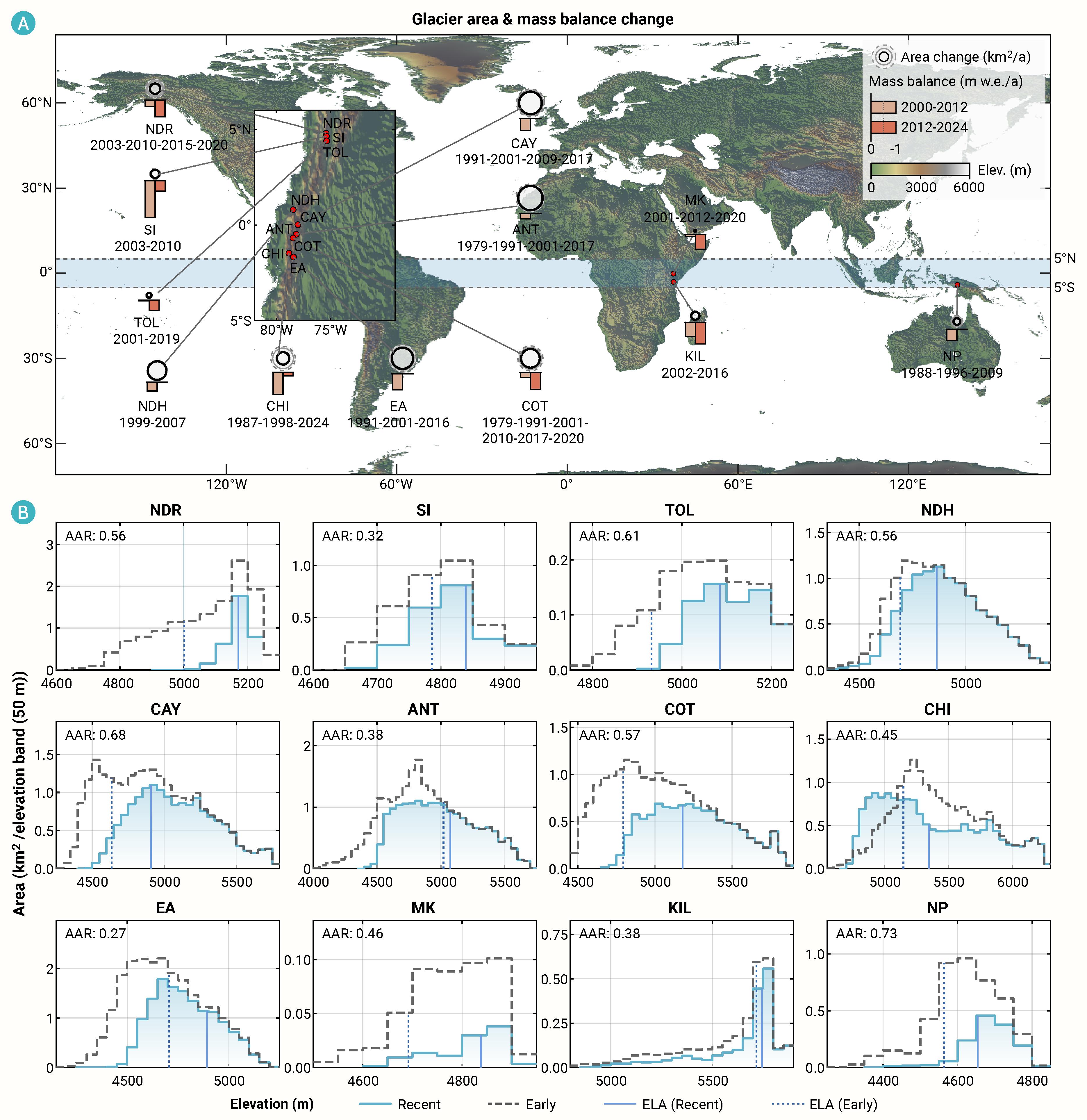
Spatiotemporal changes in glacier area and mass balance in the equatorial region since the 1980s


