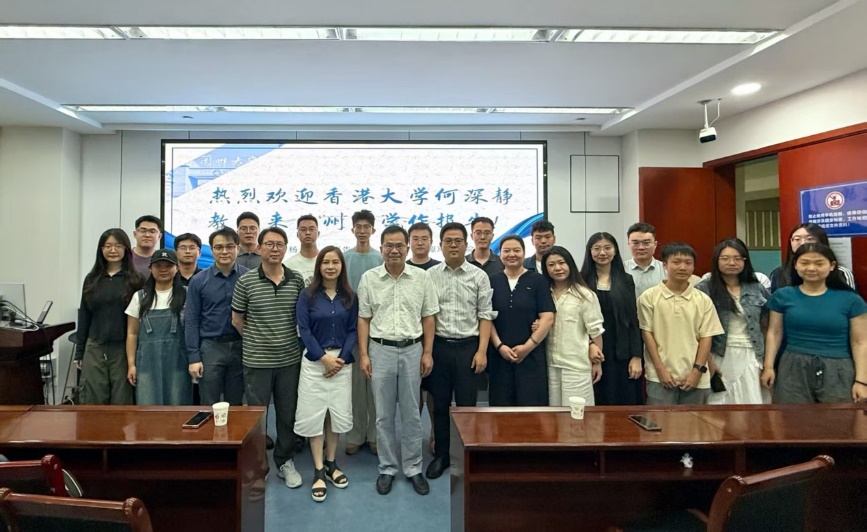
At the invitation of Prof. Yang Yongchun from the School of Earth and Environmental Sciences, Lanzhou University, and the Key Laboratory of Western China's Environmental Systems, Ministry of Education, China, Prof. He Shenjing from the University of Hong Kong visited our university for academic exchange on July 17, 2026, at Room 1615, Guanyun Building, Chengguan Campus.
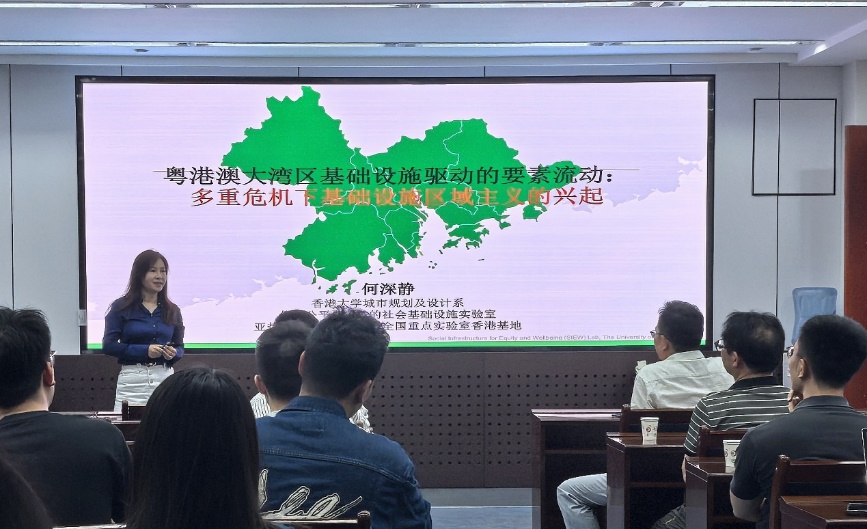
Prof. He Shenjing delivered an academic lecture titled "Infrastructure-driven Factor Mobility in the Guangdong–Hong Kong–Macao Greater Bay Area: The Rise of Infrastructure Regionalism under Multiple Crises". Against the backdrop of intertwined multiple crises—including global economic downturn, intensifying technological competition, and geopolitical frictions—Professor He constructed a theoretical framework for infrastructure-driven regional governance and the restructuring of cross-border regionalism. She pointed out that infrastructure not only fulfills traditional functions of spatial connectivity and resource allocation but also, by reshaping the flows of population, capital, knowledge, and social resources, has become a crucial instrument for promoting cross-border governance and regional coordination. The lecture analyzed the mechanisms through which infrastructure influences factor mobility from three dimensions—technological, emotional, and discursive—and systematically elucidated three forms of infrastructure-driven factor mobility—namely, mirror-type, integration-type, and enclave-type—using cases of social infrastructure such as universities, education, healthcare, and elderly care in the Guangdong–Hong Kong–Macao Greater Bay Area. This research transcends the conventional understanding of infrastructure regionalism as merely a form of spatial connectivity, expanding it into a mode of state governance that organizes mobility, reshapes regional relationships, and realizes cross-border governance. It offers new theoretical perspectives and important references for understanding cross-border regional cooperation and regional economic transformation.
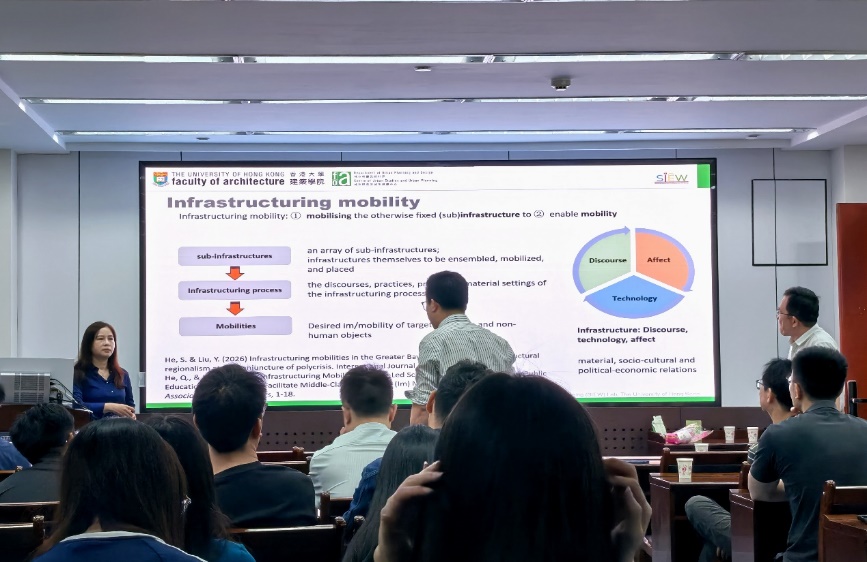
The lecture was rich in content, novel in perspective, and grounded in both theoretical depth and practical analysis, eliciting enthusiastic responses from the faculty and students in attendance. Following the lecture, participants engaged in in-depth discussions on topics such as cross-border factor mobility mechanisms and regional governance innovation, further promoting the interactive integration of theoretical exploration and practical application. This lecture broadened the attendees' understanding of the relationship between infrastructure and regional spatial restructuring, and provided new directions for interdisciplinary research in geography, regional planning, economics, and related fields.