Methane is the second most important greenhouse gas after carbon dioxide. It has a strong warming effect and a relatively short atmospheric lifetime, making methane emission reduction a key priority for achieving near- and medium-term climate mitigation targets. However, China has a vast territory and a complex mix of emission sources, with substantial regional differences in energy structure, agricultural activities, population density, and natural ecological conditions. Previous studies have largely focused on national total emissions or individual sectors, while systematic understanding of the regional patterns and uncertainties of China's methane budget remains limited. Therefore, clarifying the regional variations, dominant sources, and long-term trends of methane emissions in China is of great importance for developing differentiated emission reduction strategies, supporting the goals of carbon peaking and carbon neutrality, and advancing methane emission control initiatives.
To address this issue, Zhao Pengfei, a jointly trained doctoral student at the School of Earth and Environmental Sciences, Lanzhou University, and the Institute of Tibetan Plateau Research, Chinese Academy of Sciences, under the supervision of Professor Huang Guanghui of Lanzhou University and Researcher Zhang Zhen of the Institute of Tibetan Plateau Research, collaborated with multiple research institutions in China and abroad. Taking nine major regions of China as the study areas and adopting the methane budget framework of the Global Carbon Project, the study integrated top-down (TD) atmospheric inversion ensemble estimates and bottom-up (BU) process-based model estimates provided by international research teams. By reviewing more than 200 related studies, the researchers systematically assessed the spatiotemporal variations, major sources, and uncertainties of methane emissions and uptake across China's regions from 2000 to 2019.
The results revealed pronounced regional clustering of methane emissions in China. First, during 2010–2019, China's annual methane emissions were estimated at approximately 65.8 [48.6–94.1] Tg CH₄ yr⁻¹ using the bottom-up (BU) approach and 55.6 [38.5–78.8] Tg CH₄ yr⁻¹ using the top-down (TD) approach. Anthropogenic sources accounted for 84%–91% of total emissions, with coal mining, livestock production, rice cultivation, and landfill and wastewater treatment identified as the major emission sources. Second, North China, Southeast China, and Southwest China together accounted for approximately 60% of China's methane emissions, despite covering less than 30% of the country's total land area. In North China, emissions were primarily driven by coal mining and energy-related activities; in Southeast China, rice cultivation and waste management were the dominant contributors; while in Southwest China, emissions were driven by both energy and agricultural activities. Third, compared with 2000–2009, China's methane emissions increased further during 2010–2019, mainly driven by growth in anthropogenic emissions. This increase was partially offset by declining emissions from biomass and biofuel burning. Natural sources accounted for 9%–16% of total methane emissions, although their estimates were subject to substantial uncertainty. Natural processes such as wetlands, inland freshwater systems, and permafrost degradation therefore remain important priorities for future monitoring and assessment. The study demonstrates that methane mitigation in China should not rely solely on national-level total emission controls. Instead, more targeted monitoring and mitigation strategies should be developed according to the dominant emission sources and regional characteristics of different areas.
The research findings were recently published in Science Bulletin under the title "Two decades of methane budgets at the sub-national scale in China". The School of Earth and Environmental Sciences at Lanzhou University is the first-affiliated institution. Zhao Pengfei, a doctoral student at the School, is the first author, while Professor Huang Guanghui of Lanzhou University and Researcher Zhang Zhen of the Institute of Tibetan Plateau Research, Chinese Academy of Sciences, are co-corresponding authors. This research was supported by the National Natural Science Foundation of China (Grants 42530211, 42371365, and 42171322), the National Natural Science Foundation of China Joint Fund (Grant U24A20590), and the 2026 "Innovation Star" Program for Graduate Students of the Gansu Provincial Department of Education (Grant 2026CXZX-085).
Paper link: https://doi.org/10.1016/j.scib.2026.06.019
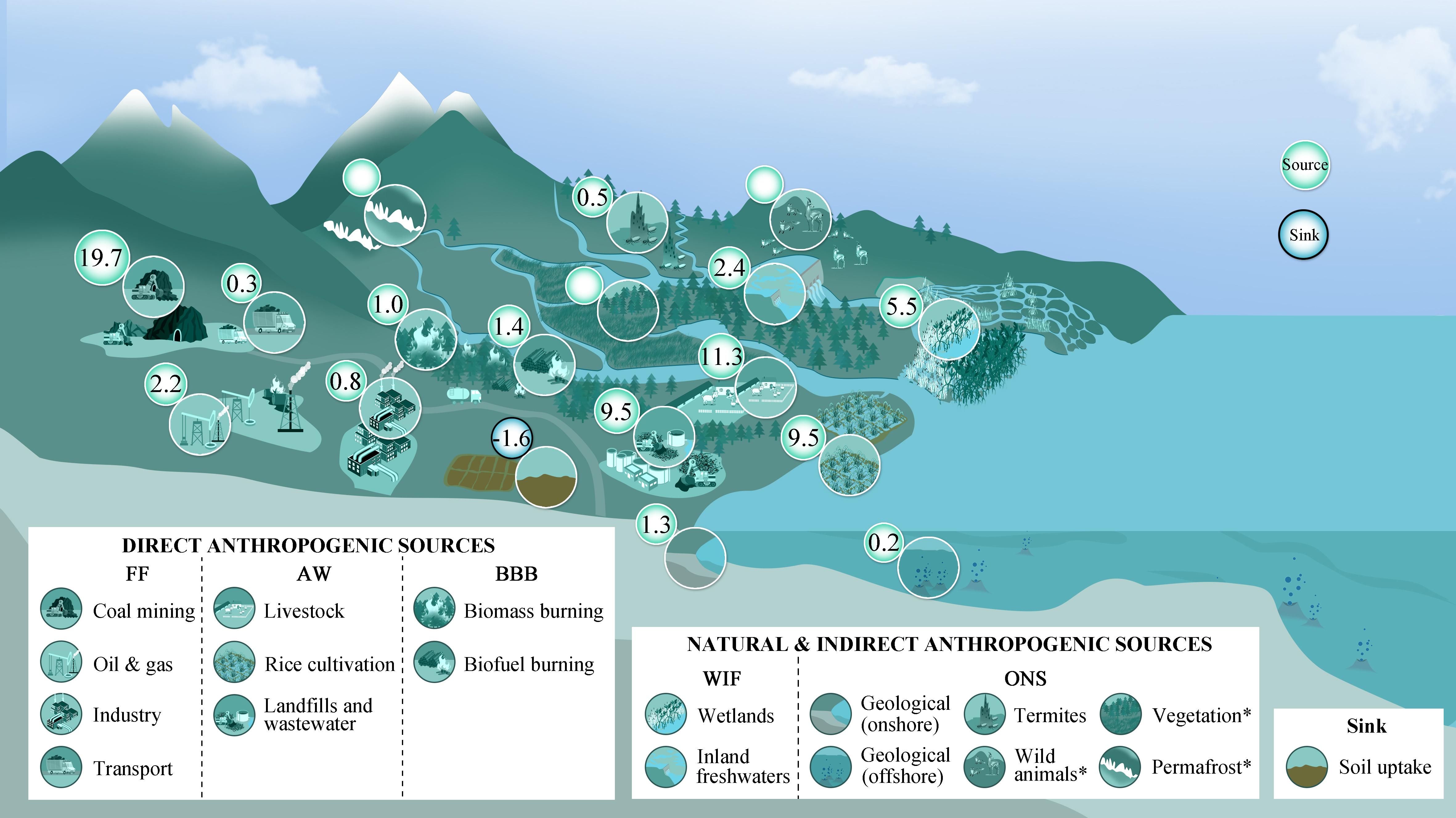
Figure 1. Major sources and sinks of China's methane budget, 2010–2019 (Tg CH₄ yr⁻¹).
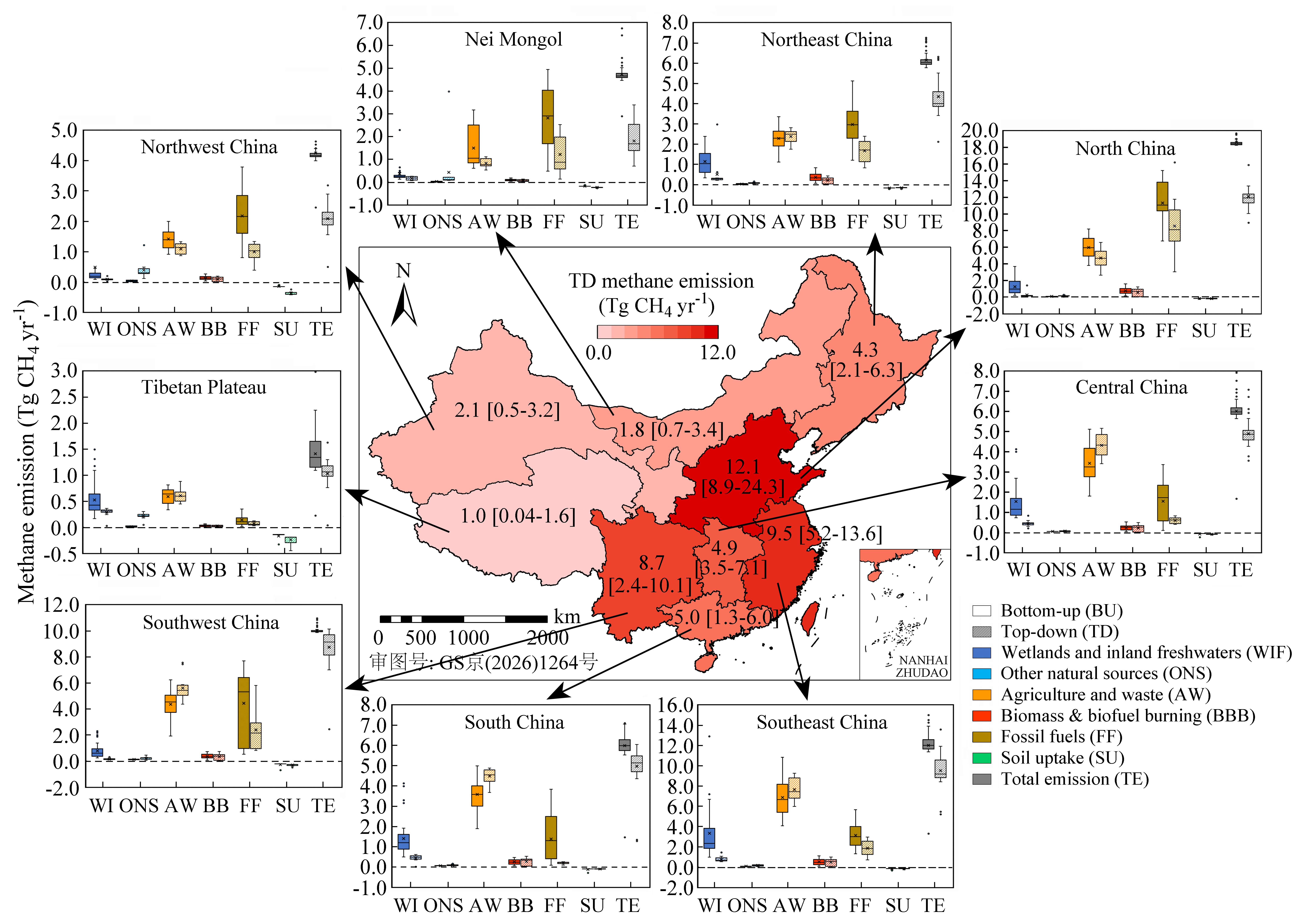
Figure 2. Methane budgets across the nine major regions of China, 2010–2019.


